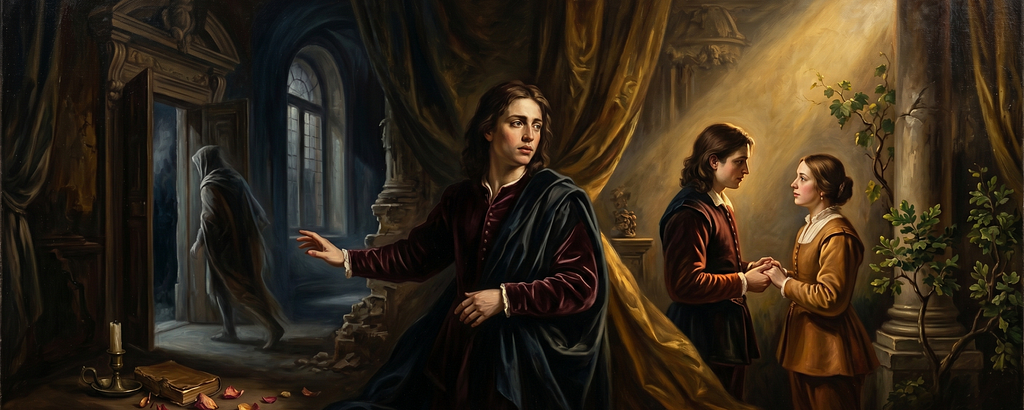
There is a tendency in people to treat love like a moral contract. As if loving one person later somehow invalidates the love that came before. As if the heart, once it moves, must expose a lie from its past.
That is not how human beings work.
Love is not a courtroom judgment. It does not declare one feeling false simply because another feeling arrived later. Love can be real in one season and still end. Another can be real in another season and begin. Both can be true. Both can be sincere. Both can change the person who lived through them.
What people often fail to understand is that love is not just a feeling. In fact, when you are inside it, it is often difficult to even name. Love is a strange state. While it is happening, you rarely understand its full shape. You mistake it for routine, for comfort, for habit, for certainty. Only after it leaves do you realise it was love.
Especially after heartbreak.
There is a sher that captures this perfectly:
“Wo jab yahan tha to hum dekhte na the usko,
wo ja raha hai to hum khidkiyan badalte hain.”
When they were here, we did not really look at them.
Now that they are leaving, we keep changing windows to catch one last glimpse.
That is the cruelty of love. It often becomes visible only in absence.
What was once ordinary suddenly becomes sacred. Their presence, which blends into daily life, becomes the very thing you cannot replace. The voice you ignored becomes the silence you notice everywhere. The person you thought would remain becomes the one memory your mind keeps returning to.
You understand when it is too late.
And perhaps this is why heartbreak changes people so deeply. It is not only the loss of a person. It is the late recognition of what that person meant.
Love asks for attention, energy, emotional availability, and the willingness to let another person occupy space inside your inner world. That takes effort. Real effort. The kind that cannot be endlessly multiplied without consequence.
You can care about many people. You can remember many people. You can carry the traces of many people. But deep love is not the same as scattered affection. It asks for presence, and presence is finite.
This is why, when someone falls in love again, they often feel guilty before they feel happy. The guilt is not always because they are doing something wrong. Sometimes it is because they are loyal to memory. They believe that moving forward means betraying what came before.
It does not.
The first love was true when it happened.
The second love is true when it happens.
Truth in emotion does not depend on permanence. It depends on honesty. A thing does not become fake simply because it ended. A season does not become meaningless simply because it has passed.
We are too obsessed with permanence. We have been taught that only what lasts deserves to be called real. But that is childish reasoning. A conversation can change you in ten minutes. A loss can redefine you in a day. A relationship can shape your emotional architecture even if it collapses later. Duration is not the same as depth.
Some people remain trapped in the idea that there should be one eternal love, one sacred person, one singular emotional destiny. That sounds beautiful in theory. In reality, it is often just a fantasy built to protect the ego from change. It is easier to believe in one absolute love than to accept that the heart can remain alive after heartbreak.
But hearts do not die with the first rupture. They adapt. They scar. They reopen. They learn.
And that is where the real discomfort begins.
Because loving again forces you to confront the possibility that what you once called “the only love that mattered” was not the only one at all. It was simply the first one that made you feel completely alive.
People confuse intensity with exclusivity. They assume that because something felt immense, it must have been final. But intensity is not proof of eternity. It is proof of depth at that moment.
Sometimes a person enters your life and becomes your entire emotional universe. Later, that universe collapses. And when another person arrives and begins to matter, you do not immediately trust the feeling. You compare it to the ruins of what came before.
That comparison is unfair to both.
The old love should not be accused of being fake just because it ended.
The new love should not be treated as a replacement just because it arrived after a loss.
They are not the same thing. They are not meant to be.
Every love belongs to a different version of you.
Some people come into your life to teach devotion. Some teach pain. Some teach timing. Some teach restraint. Some teach you what it means to be chosen. Some teach you what it means to lose what you thought would never leave.
Every one of them leaves a mark. None of them are erased by the next.
That is why people who have loved deeply often become quieter, not colder. They know the cost of emotional surrender. They know that a heart can only be handed over so many times before it starts to fear its own capacity.
Still, love remains one of the few experiences that refuses to fit neat categories. It is messy. It is cumulative. It is contradictory. You can miss the first person while being grateful for the second. You can carry tenderness for what ended while building something real with what is present.
That does not make you divided.
It makes you human.
So yes, you can love many people across a lifetime.
But not in the same way.
Not with the same body.
Not with the same emotional conditions.
Not with the same version of yourself.
And maybe that is exactly why each love matters.
Because it belongs to a different chapter of your becoming.
The first love was not a lie.
The second love is not a betrayal.
They are simply two honest truths from two different lives you lived inside the same body.